
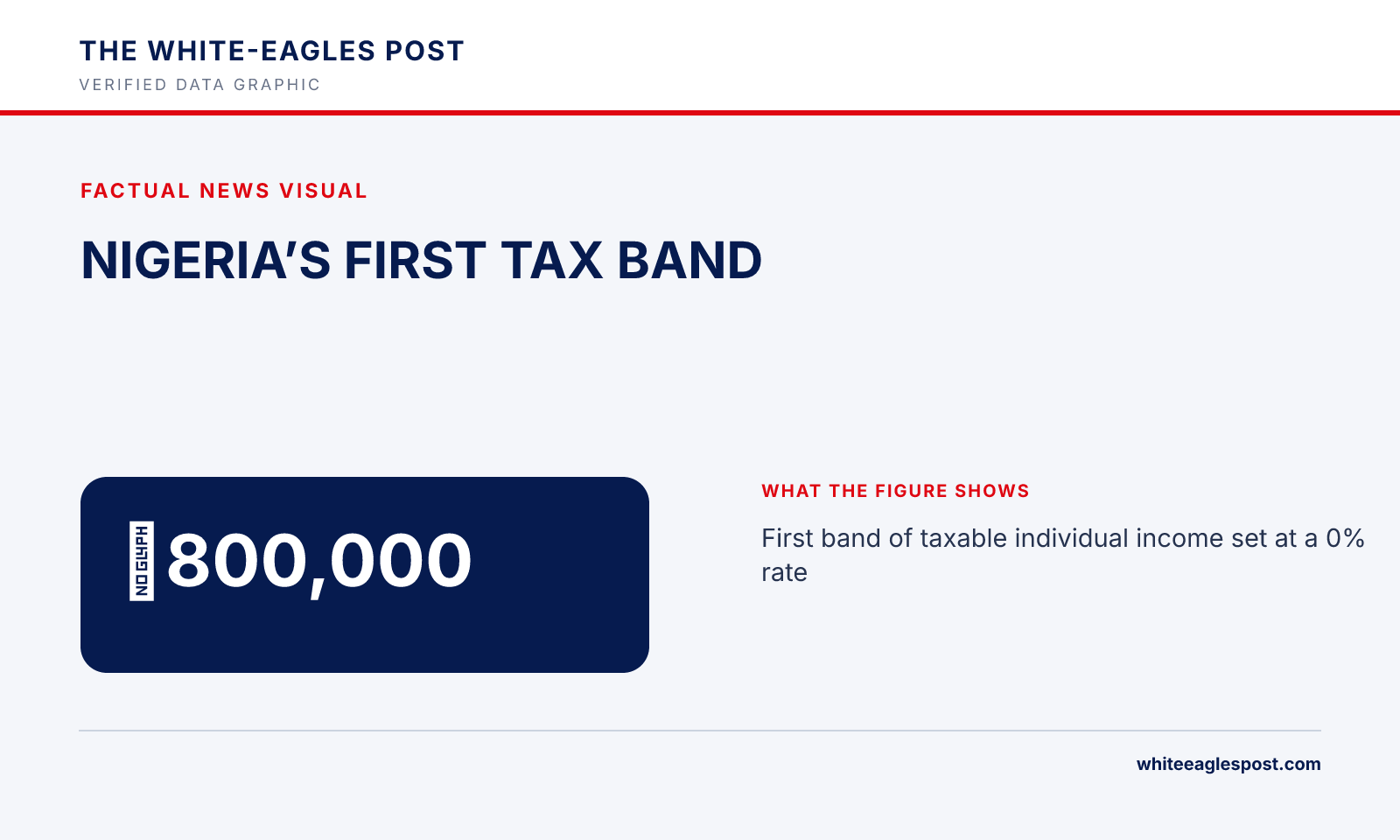
Nigeria’s 2025 tax-law framework took effect on 1 January 2026, establishing revised individual income-tax provisions that include a 0% rate on the first ₦800,000 of taxable income.
The Nigeria Tax Act also exempts employment income at or below the national minimum wage from tax. The provision applies alongside the 0% first band, which is set out in the Act for taxable individual income.
The Joint Revenue Board’s 2026 personal-income-tax guidelines retain the same structure, applying a 0% rate to the first ₦800,000 band. The guidelines place that rate within the framework used for personal-income-tax administration under the revised rules.
At its 160th meeting in Kaduna on 3 September 2026, the Joint Revenue Board reviewed progress and challenges during implementation. Executive Secretary Olusegun Adesokan said 18 state Houses of Assembly had adopted the model harmonised taxes-and-levies law.
Adesokan said the harmonised law had reduced more than 50 state and local-government collection items to nine sub-heads. He also said it ended cash collection and revenue-collection roadblocks.
The Board’s executive secretary said the reforms had reduced the tax burden for low-income earners and removed multiple nuisance taxes. The meeting considered the operation of the revised arrangements alongside the adoption of the model harmonised law by the 18 state legislatures.