
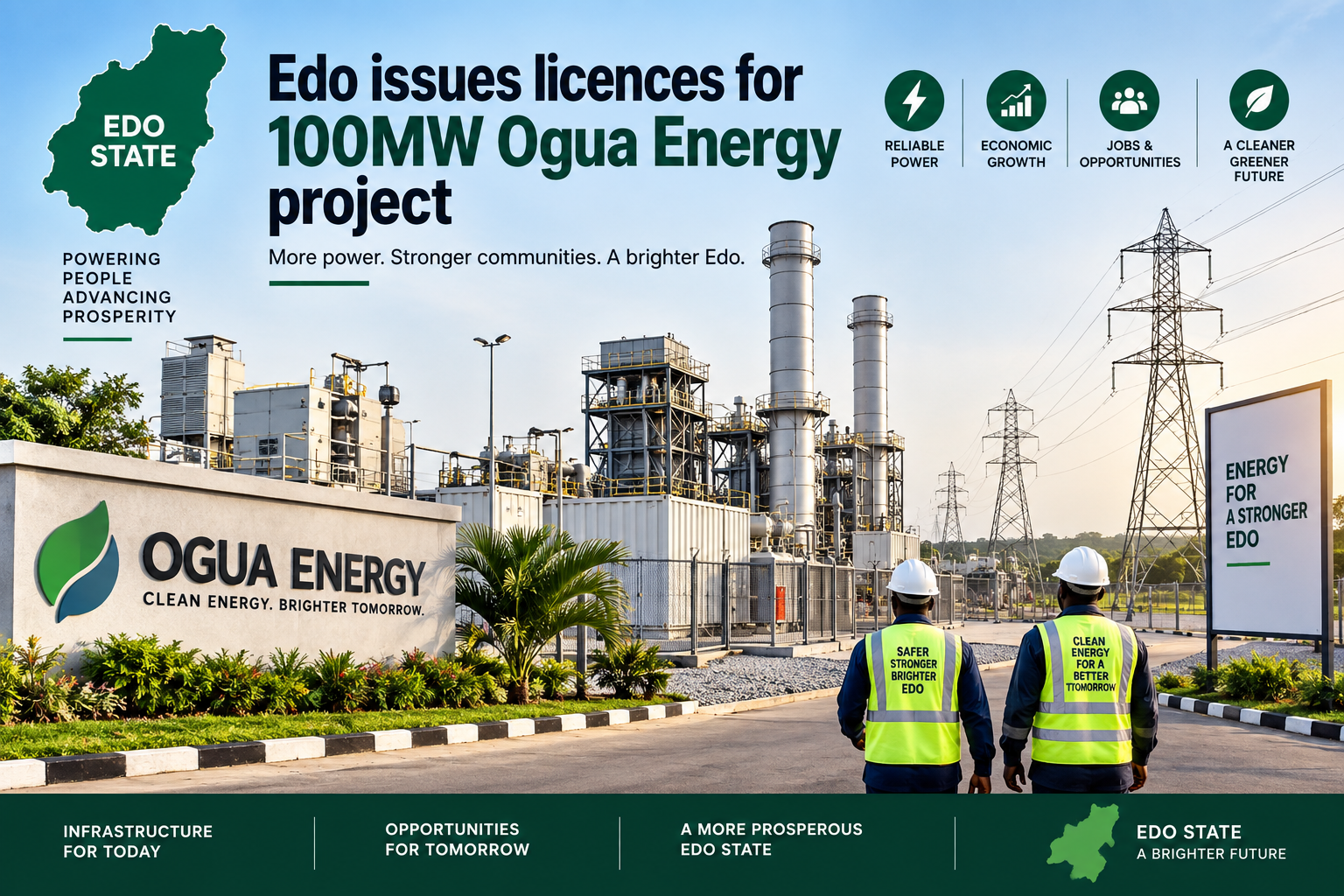
The Edo State Government has issued electricity transmission and distribution licences to CCETC Ogua Energy Limited for its 100-megawatt power project at Ologbo in Ikpoba-Okha Local Government Area.
State Commissioner for Power Paul Usenbo said the project had met key regulatory and technical requirements for its first phase, which was completed in July 2026, allowing work to proceed towards the second and final phase.
The government expects the remaining work to be completed and the plant commissioned before the end of the year, although Usenbo said the timetable could be extended to the first quarter of 2027 if unforeseen technical or regulatory challenges arise.
Most of the project’s major outstanding milestones are expected to be substantially completed by October, according to the commissioner, who said power-generation equipment was continuing to arrive at the site for installation.
The latest licences build on an earlier approval granted to CCETC Ogua Energy in April. At the time, the state issued a provisional licence for development of the 100MW independent power project, describing it as part of efforts to improve electricity supply and reduce dependence on the national grid.
The Ologbo facility is expected to combine power generation with associated transmission and distribution infrastructure, enabling electricity produced at the plant to be delivered directly within Edo’s emerging state electricity market.
In July, the Edo State Government also secured a 10 per cent equity interest in the project. Governor Monday Okpebholo said the state was not making a direct financial contribution for the stake, but had negotiated the interest in return for providing land and supporting an enabling environment for the investment.
The project forms part of a wider restructuring of Edo’s electricity sector. The state has been issuing licences for generation, distribution, mini-grid and other electricity projects under its decentralised regulatory framework. By early September, officials said more than 12 provisional licences had been issued to private-sector electricity projects.
Edo gained greater authority over its intrastate electricity market after the Nigerian Electricity Regulatory Commission transferred regulatory oversight to the Edo State Electricity Regulatory Commission. NERC said the transfer followed provisions of the Electricity Act 2023 allowing states that meet the statutory requirements to regulate electricity operations within their boundaries.
State officials say the Ogua Energy project is expected to support more reliable electricity supply, industrial activity, employment and investment. Its actual contribution to the state’s power supply will, however, depend on completion, commissioning and the successful operation of the associated transmission and distribution infrastructure.